
Qigong literally means “cultivation of energy”. It is an internal practice of slow movement, natural breath and attention — sometimes called Chinese Yoga, and accessible at any age and any level of fitness.
What is qigong?
The word consists of two parts: qi (chi) and gong (kung). Qi can be roughly translated as energy, prana or vital force. It is not an exact translation — qi is better experienced than defined. If you have come across Reiki, qi is the same syllable as ki; the same goes for Aikido. Gong means cultivation of skill, the same kung as in kung fu. Put together, the word means something like “the skill of working with energy”.
Qigong is a training method that encompasses meditation, slow fluid movement and natural breathing. You can think of it as gentle yoga: simple, accessible for any age and level. It rests on the idea that the body is full of energy we are mostly unaware of. By moving gently in accordance with the breath, tensions and blockages release, so the qi can flow freely. As the practice deepens you begin to notice that energy, and eventually to let it lead the movement.
Where qigong comes from
Qigong is old — the movement principles behind it are recorded in Chinese medical and Daoist texts going back two thousand years, and related exercises appear on silk manuscripts older than that. For most of its history it was not one system but many: forms kept inside families, temples, monasteries and medical lineages, each with its own emphasis.
The word qigong itself is modern. It came into common use in the twentieth century as an umbrella term, gathering practices that had until then been known by dozens of separate names. That is why “qigong” describes a family rather than a single method — and why two qigong classes can look entirely different from one another.
Qigong and tai chi
The two are often confused, and they do look alike from outside. Tai chi is a martial art: a set of slow, graceful movements that encode a form of combat, trained at a speed that makes the mechanics visible. Qigong is a health and meditation practice that works with energy directly and has no martial intent.
They overlap in practice, and some sets deliberately sit between them. Tai Chi Qigong Shibashi is the best known of these — eighteen movements borrowed from Yang-style tai chi and rebuilt to serve qigong. It is where many people start, because it is far simpler than a tai chi form.
Styles of qigong
Qigong forms fall broadly into two groups.
Moving qigong is what most people picture: standing, with slow continuous movement coordinated with the breath. Shibashi belongs here, as do most sets taught for health.
Still qigong is done seated or standing without visible movement, working through breath, attention and internal awareness alone. It looks like meditation and, from the inside, largely is.
Most practitioners meet moving forms first. The stillness is easier to reach once the body already knows how to soften.
What practitioners notice
Qigong is a form of meditative movement, and the changes people report tend to be the ones you would expect from breathing well and moving gently every day: deeper relaxation, a return to easier and more natural breathing, more freedom through the spine and shoulders, steadier sleep, and a different relationship to stress.
It is worth being plain here. Qigong is not a treatment and it does not replace medical care. If you have a health condition, treat qigong as something that may sit alongside your treatment, and talk to your doctor rather than to a movement teacher about the condition itself.
Qigong for beginners
Almost nothing is needed to begin: no equipment, very little space, no particular level of fitness or flexibility. Most sets can be done in ordinary clothes in a room at home.
What matters more is regularity. Twenty minutes most days does more than two hours once a week, because the practice works by accumulation rather than effort. Beginners are usually advised to learn a short set properly and repeat it, rather than collecting many forms — and to let the breath stay natural rather than trying to control it.
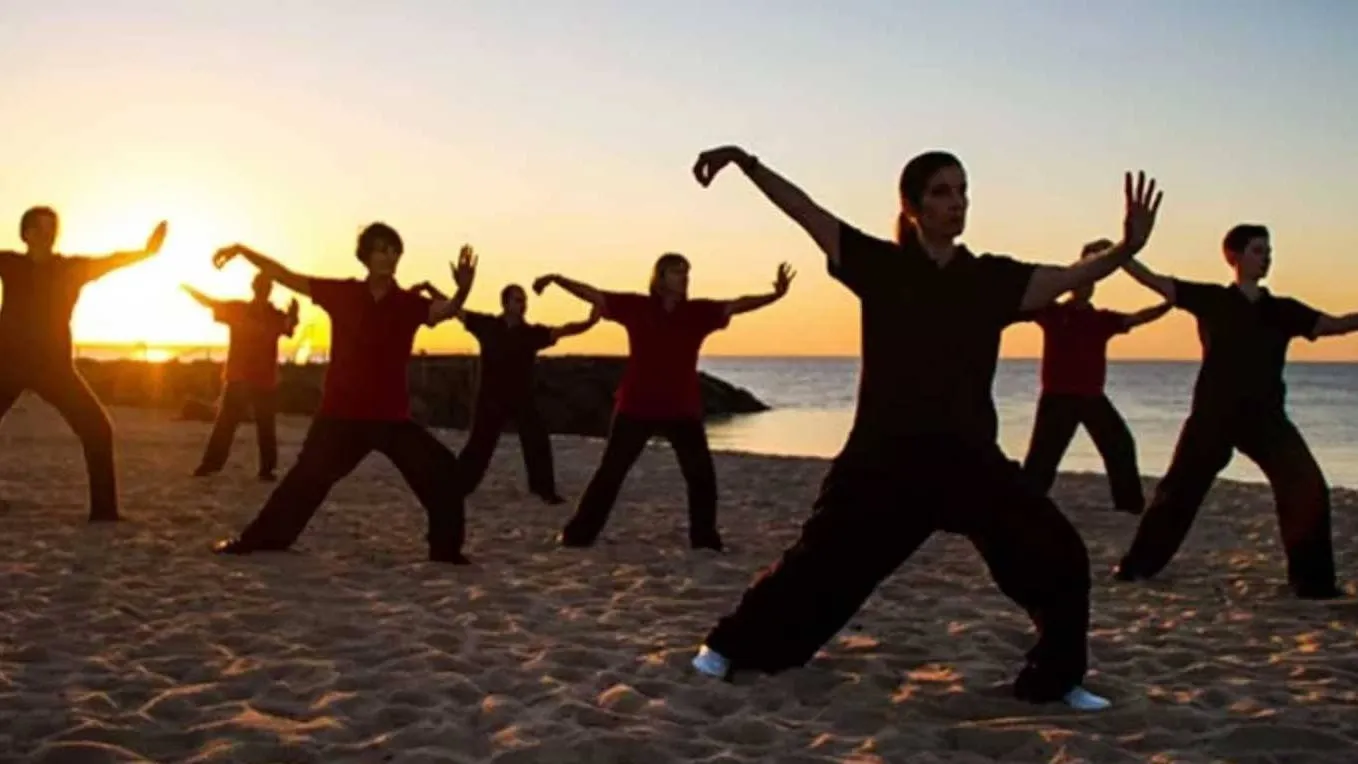 Qigong practice in Goa, India
Qigong forms we study
Come and learn the most popular forms of Qigong:
- Ba Duan Jin – 8 Pieces of Brocade
- Yi Jin Jing – Muscle Tendon Change Classic
- Wu Qin Xi – 5 Animal Frolics
- Liu Zi Jue – 6 Healing Sounds
- Wu Ji Gong – Primordial Qigong
- and other forms, styles and sequences…
Himalayan Qigong in India
Unfortunately, in India qigong is not yet as popular as in other countries. But it slowly changes — in our experience, once people try qigong they fall in love with the practice.
The school was founded in Rishikesh in 2020, in the place known as the yoga capital of the world. It combines the ancient qigong movement with modern yoga and a knowledge of western anatomy. Qigong retreats now run in the Kathmandu Valley — see retreats for what is open.
Qigong in motion
